
Nyayvarta | August 28 | Bhairavnath Wakale
(Land Reservation) Under a city’s Development Plan, private land may be reserved for public purposes such as roads, schools, gardens, playgrounds, public amenities or electricity substations. But what happens when the land remains unacquired for years despite being reserved?
(Land Reservation) An even more important question is whether land that has already been legally released from a reservation can be reserved again under a subsequent Development Plan under a different designation.
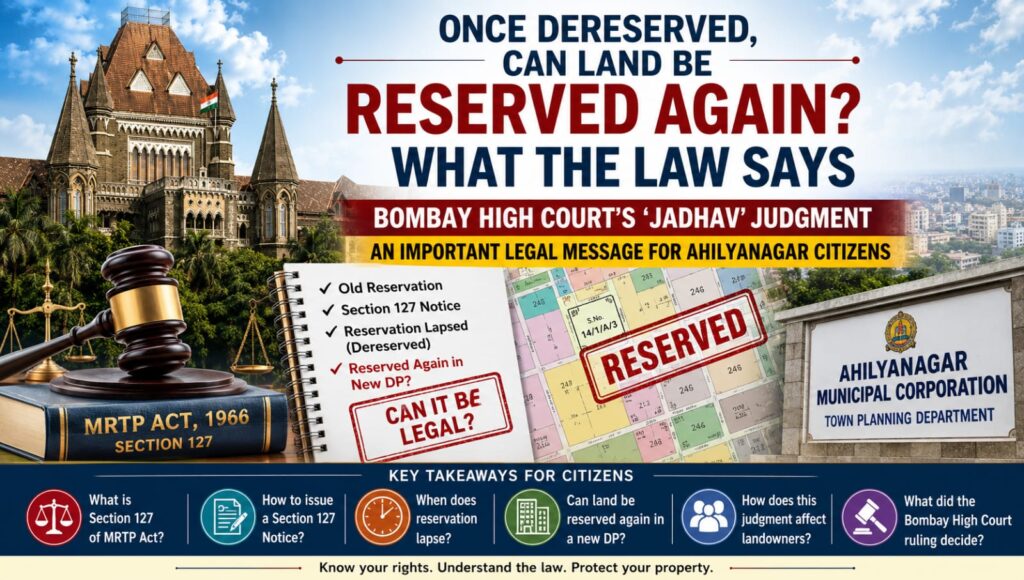
(Land Reservation)A recent significant judgment of the Bombay High Court has addressed this issue. In Baburao Gangadhar Jadhav (deceased) through legal heirs v. State of Maharashtra and Others, a Division Bench comprising Justice M. S. Karnik and Justice Ranjit Singh Rajebhosale allowed the petition on August 17, 2026.
(LandReservation) Land in Nashik, but an issue relevant across Maharashtra
The dispute concerned 1,500 sq. metres of land at Anandwali, Gangapur Road, within the Nashik Municipal Corporation area, bearing Survey No. 14/1/A/3.
Under the 1993 Development Plan, the land was reserved for an Electric Sub Station and Post Office. Since the required acquisition process was not completed within the prescribed period, the landowners issued a Purchase Notice under Section 127 of the Maharashtra Regional and Town Planning Act, 1966 (MRTP Act) on December 12, 2006. According to the court record, the notice was valid.
Meanwhile, the concerned electricity distribution company withdrew its proposal to acquire the land. A neighbouring landowner also approached the court, and in 2014 the court declared that the earlier reservation on the land had lapsed.
However, the same land was subsequently reserved under the 2017 Development Plan as “Public Amenities Space.” The Jadhav family challenged this fresh reservation before the High Court.
What did the High Court say?
The High Court held that once land has been legally released from a Development Plan reservation through the statutory process, the same land cannot subsequently be reserved again merely by changing the purpose or designation of the reservation in a later Development Plan.
While reaching this conclusion, the court relied on Supreme Court judgments including Bhavnagar University and Godrej & Boyce, as well as Bombay High Court decisions including Anil Dattatraya Girme, Trilok Singh Pahlajsingh Rajpal and Pursushotam Vishandas Raheja.
The court ultimately declared that Reservation No. 244 – Public Amenities Space on the Jadhav family’s land had legally lapsed. Directions were also issued to make the land available for development in accordance with applicable law and, where necessary, correct the relevant municipal and revenue records.
Why is this important for Ahilyanagar?
The issue is not limited to Nashik.
The official Town Planning section of the Ahilyanagar Municipal Corporation provides access to the Second Revised Approved Development Plan and Development Plan maps covering different parts of the city.
Therefore, if a privately owned plot in Ahilyanagar has a history such as:
Old Development Plan reservation → legally valid lapse/de-reservation → fresh reservation in a Revised or Second Revised Development Plan
then the principle emerging from the Jadhav judgment may become relevant to that particular case.
However, this does not mean that all reservations in Ahilyanagar will automatically become invalid. The history and legal status of each individual property must be examined separately.
An important precedent from Ahilyanagar district
For residents of Ahilyanagar district, an especially relevant case is Anil Dattatraya Girme and Others v. State of Maharashtra and Others.
The land in that case was located in Kopargaon, then part of Ahmednagar district. Under the 1988 Development Plan, Survey Nos. 103 and 104 were reserved for purposes including Garden, Open Space, Kabrasthan Park and Public Latrine.
When the land was not acquired within the prescribed period, the landowners issued a notice under Section 127. Following subsequent judicial proceedings, the land was released from the reservation.
However, under the subsequent Second Revised Development Plan, the same land was again reserved for certain changed purposes. The fresh reservation was challenged.
On February 26, 2020, the Aurangabad Bench of the Bombay High Court applied the principle that once land has been legally released from a reservation through the statutory process, an attempt to reserve the same land again under a Revised Development Plan merely for a changed purpose cannot receive legal approval.
Thus, in the geographical context of Ahilyanagar district, this legal principle has already emerged from a judicial decision.
What does Section 127 of the MRTP Act say?
Section 127 of the Maharashtra Regional and Town Planning Act, 1966 is an important provision concerning the time limit applicable to land reservations.
Broadly, where private land is reserved under a Development Plan and is not acquired within the legally prescribed period, the landowner can initiate the statutory process by issuing a Purchase Notice.
If the land is not acquired, or the necessary legal steps for acquisition are not taken within the prescribed period following the notice, the reservation may lapse by operation of law, making the land available for development in accordance with the applicable regulations.
However, an important qualification must be kept in mind.
The legal consequence depends upon factors such as when the Section 127 process was initiated, which version of the law applied at that time, when the Purchase Notice was issued and what steps were actually taken towards acquisition.
Therefore, it would be incorrect to assume that a reservation has automatically lapsed simply because “ten years have passed.”
What should landowners check?
Owners of privately held land affected by Development Plan reservations in Ahilyanagar may find it useful to examine:
1. What reservation existed on the land under the old Development Plan?
2. What was its Reservation Number?
3. When was the reservation imposed and when did the Development Plan come into force?
4. What steps did the municipal authority or government actually take to acquire the land?
5. Was a Purchase Notice issued under Section 127?
6. Was the notice properly served on the Planning Authority/Appropriate Authority?
7. Were valid acquisition steps taken within the prescribed period after the notice?
8. Was the reservation ever declared to have lapsed or the land de-reserved by a court or government authority?
9. Was the same land subsequently reserved again under a Revised or Second Revised Development Plan?
10. If so, what was the purpose of the old reservation and what is the purpose of the new one?
Only after these questions are answered can it be determined to what extent the Jadhav or Girme judgments may apply to a particular property.
What does the judgment mean for landowners?
The central principle can be put simply:
> If a reservation has legally lapsed and the land has been released from that reservation, it cannot simply be reserved again under a later Development Plan merely by changing the purpose of the reservation.
At the same time, the other side of the issue is equally important: the landowner must be able to establish that the earlier de-reservation or lapse actually occurred in accordance with law.
For this reason, landowners should preserve the complete documentary chain relating to their property, including old 7/12 extracts, mutation entries, Development Plan maps, Reservation Orders, Purchase Notices, municipal correspondence, acquisition proposals and court orders.
Further investigation needed in Ahilyanagar
Whether there are properties within the Ahilyanagar Municipal Corporation area following the pattern of:
Old reservation → legally valid de-reservation → fresh reservation under a subsequent Development Plan is a matter requiring separate examination.
If such cases are identified, the Development Plan history of each individual property can be examined to determine whether the principles laid down in Jadhav and Girme are applicable.
The objective of Nyayvarta is not to decide a dispute in favour of any party, but to explain judicial decisions and legal provisions in a manner that is understandable to ordinary citizens.
-Nyayvarta, Rayat Samachar