
Samaj Sanvad | 1 August | Principal Prakash Wakale
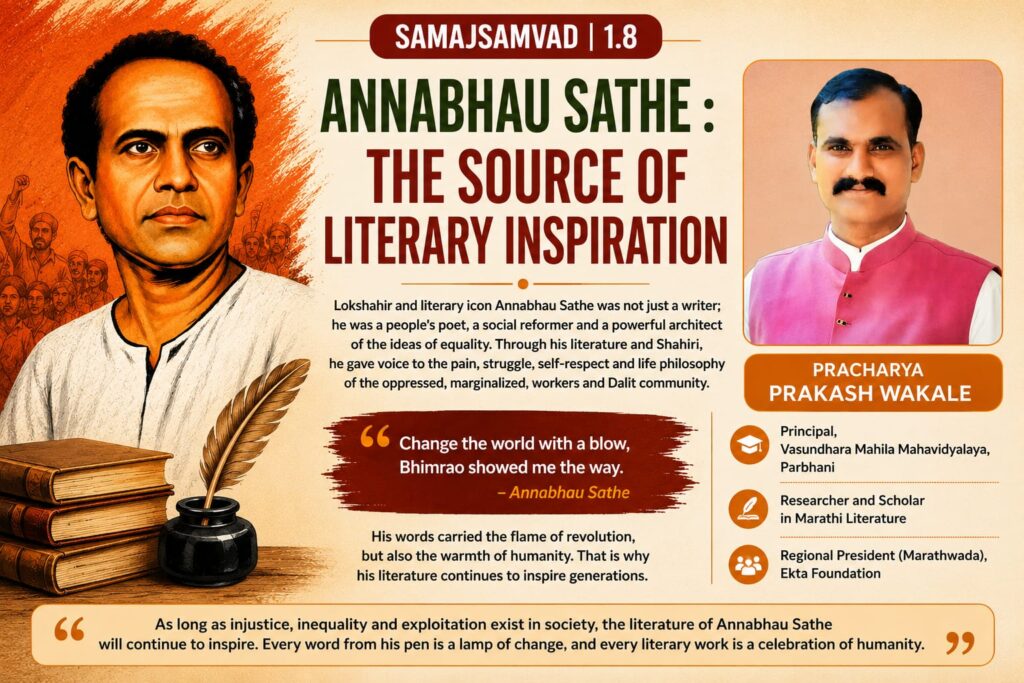
(Annabhau Sathe) In the world of Marathi literature, there are certain personalities whose writings are not merely read, they awaken social consciousness, inspire people to fight against injustice, and give human beings the confidence to live with dignity. Lokshahir and Sahityasamrat Annabhau Sathe was one such luminous personality.
He did not consider literature merely a means of entertainment; instead, he transformed it into a powerful instrument of social change. Through his writings, he gave voice to the pain, struggles, self-respect and lived experiences of the marginalised, deprived, working-class, nomadic and denotified, and Dalit communities.
“Jag badal ghaluni ghaav, sangun gele mala Bhimrao” – “Change the world by striking against injustice; this is what Bhimrao told me.” This line by Annabhau Sathe is not merely a song; it is a declaration of social transformation. Through his shahiri and literary works, Annabhau Sathe performed the historic task of taking Dr. Babasaheb Ambedkar’s ideas of equality to the masses.
His writing carried the fire of revolution, while his words were filled with the warmth of humanity. That is why Annabhau Sathe was not merely a writer; he was a Lokshahir who gave words to the pain of the people, a pioneer of social transformation and an influential architect of the ideals of equality.
Annabhau Sathe was born on 1 August 1920 in Wattegaon, in Sangli district, into extreme poverty. He had almost no opportunity for formal education. However, life itself became his university. He closely experienced labour, hunger, migration, injustice and struggle. Therefore, his literature was not based on artificial imagination; it emerged from his direct experiences of life.
Despite having no formal academic degree, he enriched Marathi literature through extensive writing in various genres, including novels, short stories, folk plays, powadas, lavanis, dramas, screenplays and travelogues. He wrote more than 35 novels, along with numerous short-story collections, powadas, folk plays and other literary works.
The Power of Realist Literature
The essence of Annabhau Sathe’s literature is realism. Rather than immersing himself in fantasy, he portrayed the lives of real people in society. The characters in his stories do not live in palaces; they are people living in slums, earning their bread through hard work, enduring injustice, yet rising against injustice when the moment demands it. Therefore, while reading his literature, readers see a reflection of their own society.
Vivid Characterisation
One of the greatest strengths of his writing is his creation of vivid and lifelike characters. Whether it is the protagonist of Fakira, an ordinary person from the Warana Valley, or a character associated with the lives of workers, every character feels real and human. His characters cry, laugh, struggle and face defeat, but they rise again with renewed determination. These characters do not merely serve to advance the plot; they bear witness to the history of society.
Giving Literary Dignity to the Language of the People
Annabhau’s language was the true strength of his literature. He gave literary recognition and dignity to the language of ordinary people. He effectively used rural dialects, the vocabulary of workers, proverbs, idioms, rhythm and the musicality of folk life. As a result, his writing possesses simplicity, an effortless flow and an authentic touch of life.
Literature with a Social Message
His literature powerfully portrays social inequality, caste-based injustice, economic exploitation, women’s issues, the lives of workers, the suffering of migrants and the struggle for human dignity. He brought Dalit, working-class and marginalised communities to the centre of literature. Through his writing, Marathi literature acquired a new and powerful social dimension.
His Contribution as a Lokshahir
Through powadas, lavanis, folk theatre and shahiri, he created social awareness among the masses. He used his art to communicate the values of the Samyukta Maharashtra movement, workers’ rights, freedom, equality and social justice to the people. His shahiri was not limited to entertainment; it was a torch of social transformation.
Why Annabhau’s Literature Remains Relevant Today
Although society is rapidly changing due to science, technology and globalisation, problems such as inequality, unemployment, injustice and the decline of human sensitivity continue to exist. In such times, Annabhau Sathe’s literature teaches the new generation the values of social responsibility, equality, fraternity and humanity.
“The Earth does not rest on the head of Shesh; it stands upon the hands of the working people.” This statement encapsulates his entire philosophy of dignity of labour and social equality.
On the occasion of his birth anniversary, merely offering floral tributes is not enough. Studying his literature, understanding its social message and resolving to build an egalitarian society would be the true tribute to his legacy.
Annabhau Sathe was not merely a writer in the world of Marathi literature; he was a thinker who awakened society through literature, a Lokshahir and an architect of social transformation. The fountain of his literature continues to flow even today. From this fountain, the nectar of equality, self-respect, dignity of labour and humanity continues to flow endlessly.
“As long as injustice, inequality and exploitation exist in society, Annabhau Sathe’s literature will continue to inspire society. Every word from his pen is a lamp of transformation, and every literary work is a celebration of humanity.”
(The author is the Principal of Vasundhara Mahila Mahavidyalaya, Parbhani, a researcher and scholar of Marathi literature, and the Marathwada Divisional President of Ekta Foundation.)