

A call to preserve the memorial sites associated with the Phules during the Mahatma Phule Bicentenary Year
Ahilyanagar | 31 October | Bhairavnath Wakale
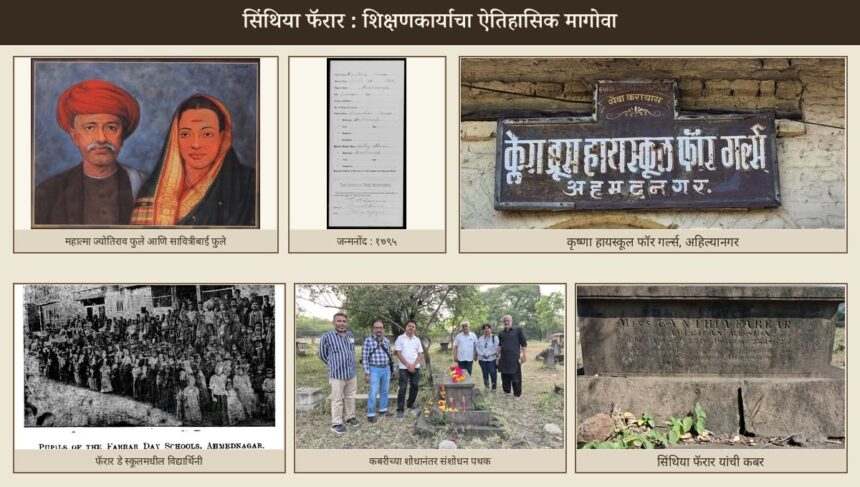
(Cynthia Farrar’s Grave) While documenting the history of women’s education in India, the contributions of Mata Savitribai Phule and Mahatma Jyotirao Phule rightfully occupy a prominent place. The struggle waged by the Phule couple to ensure that women received the right to education, became educated and self-reliant, and freed themselves from social and cultural oppression remains an important chapter in India’s social history.
(Cynthia Farrar’s Grave) However, an American woman from historical Ahmednagar, now known as Ahilyanagar, played a significant role in Savitribai’s early educational development and in shaping Mahatma Phule’s thoughts on women’s education. Her name was Miss Cynthia Farrar.
(Cynthia Farrar’s Grave)Miss Cynthia Farrar was an American missionary, teacher and educationist who dedicated her entire life to religious work as well as the cause of women’s education. Her association with Savitribai’s teacher training remains an important historical connection. Mahatma Phule also referred to her educational work in his writings. Interestingly, the principal field of her work was Ahmednagar, now Ahilyanagar. She passed away in this very city on 25 January 1862 and was laid to rest here.
The discovery of her grave has given us an opportunity to bring the contributions of this remarkable educationist, who has remained relatively overlooked in the history of women’s education, back into the spotlight.
Born in America, devoted to education in India
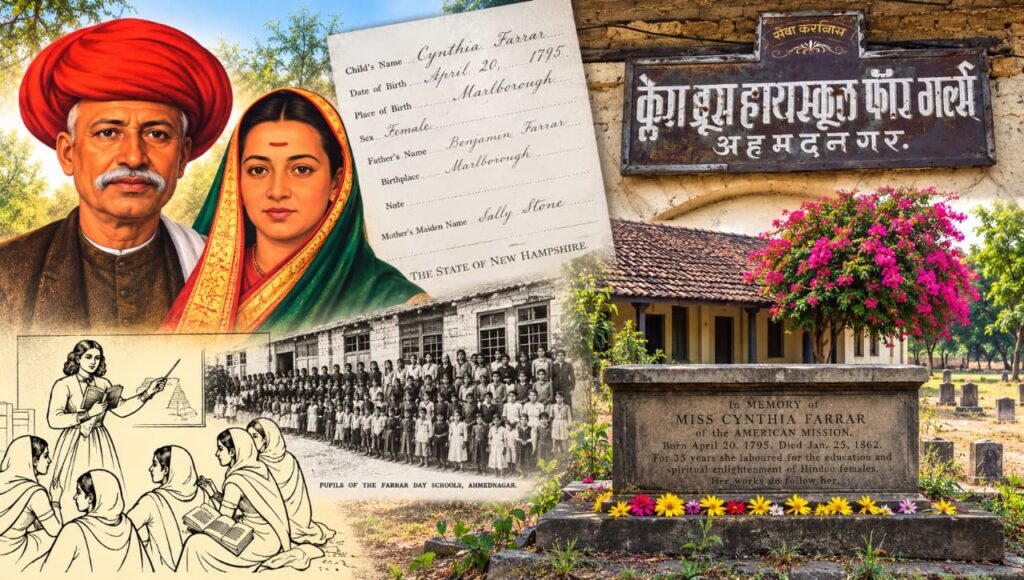
Miss Cynthia Farrar was born on 20 April 1795 in Marlborough, New Hampshire, USA. The Ahmednagar History Lovers’ Association recently obtained a copy of her birth record. She is recognised as one of the earliest unmarried women missionaries associated with the American Marathi Mission.
Coming to India in the nineteenth century to undertake educational and social work was a considerable challenge for women. At a time when such opportunities were limited, Farrar decided to dedicate herself to the education of girls.
She arrived in Mumbai on 29 December 1827. After joining the work of the American Marathi Mission, she devoted herself to promoting girls’ education. Initially, she worked in Mumbai. Due to ill health, she returned to America in 1837. However, she came back to India in 1839 and subsequently made Ahmednagar the centre of her work.
Strengthening the foundation of girls’ education in Mumbai
When Cynthia Farrar arrived in India, educating girls faced considerable opposition from certain sections of society. The prevailing social mindset suggested that girls did not need education and that their lives should remain confined to household responsibilities and child marriage. Attempts were continually made to reinforce these regressive beliefs through religious texts, traditional narratives and conservative interpretations.
The American Marathi Mission had established a school for girls in Mumbai in March 1824. A local woman named Gangabai taught at the school. However, she died during a cholera outbreak, and the school’s activities came to a halt.
Subsequently, efforts were made to reopen schools for girls. By 1826, nine girls’ schools were functioning, with 204 students enrolled. Towards the end of 1827, Cynthia Farrar joined the mission’s activities and made special efforts to improve the quality of these schools.
According to the mission’s 1829 report, more than 400 girls were studying in its schools. Of these, 122 could read proficiently and write in good handwriting.
The 1834 report mentions Miss C. Farrar as the superintendent of girls’ schools in Mumbai. In 1836, she also established a separate boarding school for girls in the city. These initiatives reflected her administrative abilities, dedication to education and deep commitment to the cause of educating girls.
Carrying forward the cause of women’s education in Ahilyanagar
After returning to India in 1839, Cynthia Farrar continued her work in girls’ education in Ahmednagar. During that period, Ahmednagar was an important centre for the educational and social activities of the American Marathi Mission.
It was during this time that she wrote letters from Nagar to her sister Nancy and her parents, sharing updates about life in the city. These letters are particularly worth reading. As one goes through them, it feels as though one has travelled back in time.
She consistently worked to bring girls to school, convince parents of the importance of education, maintain student attendance and manage educational institutions. According to the American Marathi Mission’s annual reports of 1845 and 1846, four girls’ schools were functioning under her supervision, with more than a hundred students enrolled.
She faced several challenges, including child marriage, parents’ indifference towards education and social opposition. She personally ensured that students did not discontinue their education. Encouraging girls to develop an interest in learning, maintaining communication with parents and building affectionate relationships with them were distinctive features of her approach.
Her contribution remains significant in the history of girls’ education in Ahilyanagar. We must recognise and acknowledge this historical debt.
The teacher of Savitribai Phule
The most significant connection between Cynthia Farrar’s work and Maharashtra’s social history is her association with the teacher training of Krantijyoti Savitribai Phule.
Savitribai’s initial education was undertaken at home under the guidance of Mahatma Jyotirao Phule. She subsequently received training necessary for teaching. Historical references to this training mention Miss Farrar’s school in Ahmednagar, now known as Clara Bruse Girls’ High School, and Miss Mitchell’s Normal School in Pune.
In his first memorial lecture on Savitribai Phule, delivered for NCERT in 2008, the late historian Dr. Hari Narke recorded that Savitribai had received teacher training at Miss Farrar’s institution in Ahmednagar and at Miss Mitchell’s Normal School in Pune.
An article on the subject published in The Indian Express on 26 February 2022 also referred to Dr. Hari Narke’s research.
These historical references establish the place of Miss Cynthia Farrar’s school in Savitribai’s journey towards becoming a teacher. Savitribai subsequently taught in girls’ schools in Pune and also served as a headmistress.
This chapter of Savitribai’s educational journey, associated with Ahilyanagar, holds special significance in the history of women’s education in Maharashtra.
The inspiration received by Mahatma Phule
The relationship between Miss Cynthia Farrar and Mahatma Phule was not limited to teacher training alone. Jyotirao Phule himself recorded that observing Farrar’s girls’ schools inspired him in his efforts to promote women’s education.
Jyotirao’s friend, Sadashiv Govande, was employed in a British government office in an old building near the Sahakar Krida Mandal at what is now Bhausaheb Firodia High School in Ahmednagar. Phule frequently visited him. On one such occasion, Jyotirao Phule accompanied Govande to visit Miss Farrar’s school.
He was impressed by the education imparted to the girls, the management of the school and its teaching methods.
In his 1853 memorandum, Jyotirao referred to visiting the schools run by Miss Farrar of the American Mission in Ahmednagar along with a friend. He mentioned that he was delighted to see the manner in which girls were being educated there.
After returning to Pune, he intensified his efforts to establish schools for girls. Furthermore, in the memorandum submitted before the Sir William Hunter Education Commission on 19 October 1882, Jyotirao referred to earlier Christian missionary schools that had inspired his work towards women’s education.
The American Marathi Mission’s 1862 annual report, in its memorial tribute to Miss Cynthia Farrar, also mentions that Farrar had advised and guided a young man from Pune in establishing schools for girls.
Although the young man’s name is not mentioned, correlating this reference with other historical records indicates that it is associated with Mahatma Jyotirao Phule.
These accounts demonstrate that Miss Cynthia Farrar’s work was not limited to Ahmednagar, now Ahilyanagar. Her contribution was connected to the broader movement for women’s education across Maharashtra.
Development Chavan also informed us that among the schools established by Mahatma Phule in Maharashtra, one was located in Bhingar. He emphasised the need to establish a memorial site there as well.
Kamal Parkhe’s research-based biography
The research undertaken by senior journalist Kamil Parkhe has played an important role in bringing Cynthia Farrar’s life and contributions to the history of women’s education in Maharashtra before the public.
After studying the American Marathi Mission’s annual reports, historical documents, records in old periodicals and various biographical works, Parkhe wrote a Marathi biography of Cynthia Farrar.
The book is titled *Savitribai Phule Yanchya Shikshika: Cynthia Farrar* (Savitribai Phule’s Teacher: Cynthia Farrar). It has been published by Vimalkirti Prakashan, Chalisgaon, Maharashtra.
This biography is an important reference work that introduces Marathi readers to Farrar’s life and contributions. It is particularly useful for understanding the historical connection between Savitribai Phule’s teacher training and Ahmednagar, as well as the history of the inspiration Mahatma Phule received in his work for women’s education.
Through this research, Miss Cynthia Farrar’s identity has been brought forward not merely as that of a missionary woman but as an important personality in the development of women’s education in Maharashtra.
35 years of educational service and her death in Ahmednagar
Miss Cynthia Farrar spent nearly 35 years in India working towards education and social reform. She devoted her life to the management of girls’ schools, teaching and the promotion of education in Mumbai and Ahmednagar.
She passed away in Nagar on 25 January 1862, at the age of 66.
The English inscription on her grave records her birth and death dates and states that she worked for 35 years towards the education and spiritual enlightenment of Hindu women.
The final sentence on her grave is particularly meaningful:
“Her works do follow her.”
Indeed, her work continues to bear witness to her legacy through Maharashtra’s progress in women’s education, the history of Savitribai Phule’s teacher training, Mahatma Phule’s writings and the educational traditions of girls’ education in Ahilyanagar.
Discovery of Cynthia Farrar’s grave after 164 years
Friday, 16 October 2026
Although historical records established that Miss Cynthia Farrar had died in Ahmednagar, the exact location of her grave remained unknown for many years.
A memorial stone bearing her name was being shown at a cemetery in America. However, since she had died in Nagar and her mortal remains had never been taken to America, it was reasonable to conclude that her grave must be somewhere in Nagar itself. This became the starting point of the search.
Historical records, oral accounts, American Marathi Mission annual reports, cemetery inscriptions and other available historical documents were studied to trace her grave.
The research team of the Ahmednagar History Lovers’ Association initially searched the cemetery in the Siddharthnagar area, along with senior journalist Kamil Parkhe. However, the grave could not be located there.
The search was subsequently shifted to St. Xavier’s Cemetery, situated behind Damdi Masjid on Burhannagar Road, a short distance from the Bhuikot Fort.
On Friday, 16 October 2026, the team began inspecting old graves and examining their inscriptions at 7 a.m.
At approximately 10:15 a.m., Engineer Abhijit Eknath Wagh noticed the name Miss Cynthia Farrar clearly engraved on a stone grave.
Master Kaka, also known as Asif Khan Dule Khan, and Bhairavnath Wakale immediately joined him at the site. After examining the dates of birth and death and the memorial inscription, the team confirmed that this was indeed the grave of Miss Cynthia Farrar.
Senior journalist Kamil Parkhe’s historical research and guidance played an important role in this discovery. Sandhya Medhe, Samuel Waghmare and retired principal Dr. Sudhakar Kurhade also extended valuable support.
The actual search was undertaken by Engineer Abhijit Eknath Wagh, Secretary of the Ahmednagar History Lovers’ Association, its President Asif Khan Dule Khan, and Bhairavnath Wakale.
The name and memorial inscription on the old stone grave, situated beneath a banyan tree, are still clearly legible.
The inscription reads:
In the memory of
Miss Cynthia Farrar of the American Mission
Born April 20, 1795 Died January 25, 1862. For 35 years she laboured for the education and spiritual enlightenment of Hindoo females.
Her works do follow her.
The discovery of this grave, which had remained neglected for a long time, marks an important moment in historical research into Ahilyanagar’s connection with the educational work of Mahatma Phule and Savitribai Phule.
The need to preserve our historical connections
The history of women’s education in Maharashtra has been shaped by the contributions of several individuals. The role played by Mahatma Jyotirao Phule, Savitribai Phule, Fatima Sheikh and their contemporaries in giving direction to the movement for women’s education is well documented.
Miss Cynthia Farrar’s contribution is equally significant in this history. An unmarried American woman came to India and dedicated her life to educating girls despite the adverse social circumstances of the time.
Her work inspired Mahatma Phule and established an important connection with Ahilyanagar in Savitribai’s journey towards becoming a trained teacher.
With the discovery of her grave, this forgotten chapter of Ahilyanagar’s history has once again come to light.
This is not merely the grave of an American missionary woman. It is a witness to the history of women’s education in Maharashtra, a historical link connecting Ahilyanagar with Savitribai Phule’s educational development, and an important piece of evidence of the inspiration behind Mahatma Phule’s work for women’s education.
Discovering the grave of Savitribai Phule’s teacher, Cynthia Farrar, is therefore not simply the discovery of an individual’s resting place. It is the rediscovery of an important and forgotten chapter in the history of women’s education in Maharashtra.
Clara Bruse Girls’ School, situated on Station Road, a short distance from Maliwada Bus Stand, is also historically connected to the tradition of girls’ schools established by this mission.
This school, which has been “sanctified by the footsteps of Mahatma Phule, Savitribai and Cynthia Farrar”, is reportedly facing attempts by certain anti-social elements to shut it down, allegedly with the support of government machinery.
The Government of India has organised the bicentenary commemorations of Mahatma Jyotirao Phule from 11 April 2026 to 11 April 2028. The Maharashtra Government has also designated the period from 11 April 2026 to 10 April 2027 as the Mahatma Phule Bicentenary Birth Anniversary Year. Various programmes are being undertaken at the government level to mark this occasion.
In this context, Ahilyanagar District Collector Dr. Pankaj Aashiya should personally visit the historical sites associated with the work of Mahatma Phule, Savitribai Phule and Miss Cynthia Farrar.
After assessing the present condition of these sites and witnessing their deterioration, he should submit proposals to the state government for their preservation and development or initiate the necessary measures within his administrative authority.
The government should revive and develop Clara Bruse Girls’ High School, which is historically associated with the educational journey of Savitribai Phule and Miss Cynthia Farrar, as an Ideal Model School.
At present, the school is under an administrator, and questions have been raised regarding its current condition and management. The District Collector, Dr. Pankaj Aashiya, should take the initiative to ensure that this historic institution does not shut down.
The school is currently under an administrator, and it is alleged that administrative negligence has contributed to the situation in which *”Savitribai’s school”* is on the verge of closure. We intend to meet the District Collector soon to raise these concerns.
Preserving the historical legacy of Ahilyanagar, conserving the sites associated with Mahatma Phule and Savitribai Phule, protecting Miss Cynthia Farrar’s grave, locating her original photograph, documenting the work of the Phule couple and Farrar, and ensuring that their contributions reach future generations are now our collective responsibilities.