
Focus on Annual Audits, Internal Complaints Committees, and District Nodal Officers
New Delhi | June 20 | Rayat Samachar
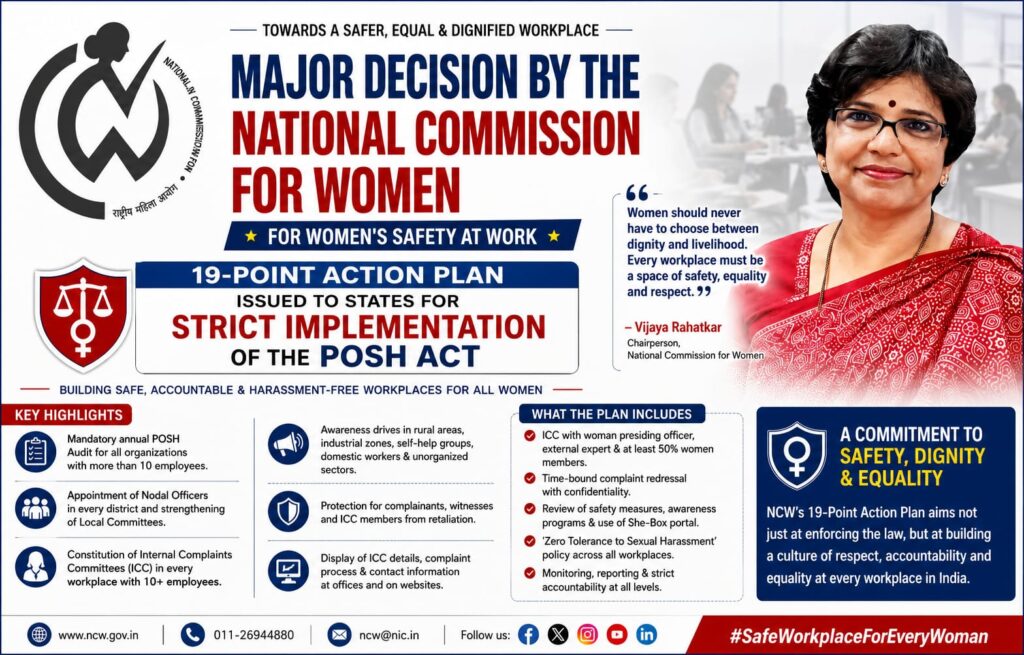
(POSH Act) In a significant move aimed at ensuring that every workplace in India is safe, dignified, and free from sexual harassment for women, the National Commission for Women (NCW) has issued a comprehensive 19-point action plan for the effective implementation of the Sexual Harassment of Women at Workplace (Prevention, Prohibition and Redressal) Act, 2013 (POSH Act). The Commission has forwarded the framework to state governments and urged its strict implementation.
(POSH Act) The directives have been sent to Chief Secretaries, Directors General of Police, District Collectors, and Police Commissioners across the country, emphasizing accountability at every level—from the state administration down to the district level.
(POSH Act) “No woman should ever have to choose between her dignity and her livelihood. Every workplace must become a space of safety, equality, and respect,” said NCW Chairperson Vijaya Rahatkar.
Annual POSH Audits for Organizations with More Than 10 Employees
The Commission has recommended mandatory annual POSH audits for all government, semi-government, and private organizations employing ten or more people. These audits will assess the functioning of Internal Complaints Committees (ICCs), grievance redressal mechanisms, confidentiality standards, workplace safety measures, awareness initiatives, and the use of the She-Box portal. Institutions failing to conduct audits may be considered non-compliant with the recommended framework.
District Nodal Officers and Stronger Local Committees
To ensure effective implementation of the POSH Act, the Commission has directed states to appoint nodal officers in every district. It has also emphasized strengthening Local Committees to address complaints from women working in organizations with fewer than ten employees, domestic workers, and those employed in the unorganized sector.
Internal Complaints Committees Mandatory
All government departments, public sector undertakings, educational institutions, hospitals, local self-government bodies, and workplaces with ten or more employees are required to establish Internal Complaints Committees (ICCs). These committees must include a woman presiding officer, an external expert member, and at least 50 percent women members.
Organizations have also been directed to prominently display information regarding committee members, complaint procedures, and contact details both at workplaces and on official websites. The framework further stresses protection for complainants, witnesses, and committee members against retaliation.
Awareness Campaigns in Rural and Unorganized Sectors
The Commission has called for extensive awareness campaigns in rural areas, industrial zones, self-help groups, among domestic workers, and across the unorganized sector. It has also urged all institutions to adopt a “Zero Tolerance to Sexual Harassment” policy.
According to the NCW, the objective of the initiative is not merely legal compliance but the creation of a workplace culture rooted in safety, dignity, accountability, and equality.
The POSH Act, enacted in 2013 following the Supreme Court’s Vishaka Guidelines, was designed to prevent workplace sexual harassment, ensure timely redressal of complaints, and promote safe working environments for women. The Commission’s new action plan comes amid concerns regarding inconsistent implementation of the law across various institutions.