
Social Dialogue | June 28 | By Rahul Jadhav
New Delhi | Rayat Samachar
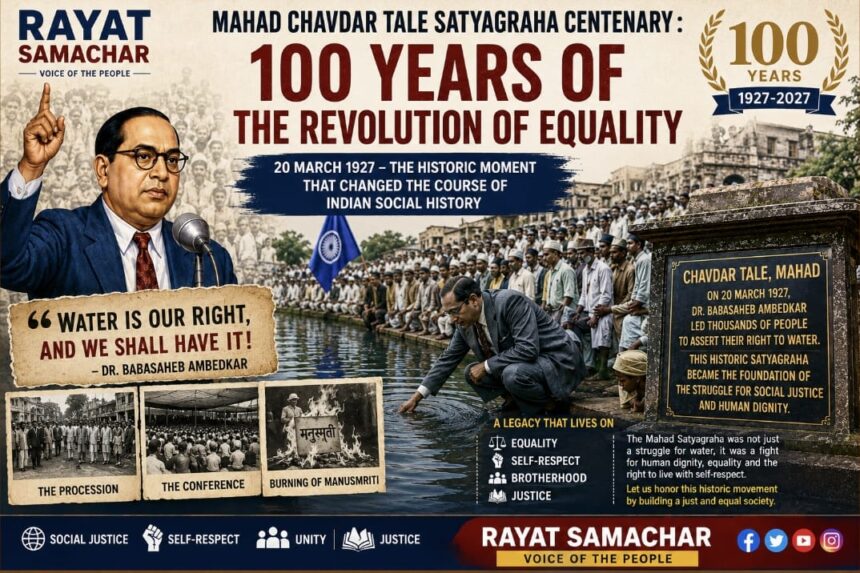
(Mahad Satyagraha) The Mahad Chavdar Tale Satyagraha is recognized worldwide as a landmark movement for social justice and equality. It is regarded as one of the most significant events in India’s social history. Led by Dr. B. R. Ambedkar on March 20, 1927, the movement gave a new direction to the struggle for social equality, human dignity, and constitutional rights. The year 2026 marks the centenary of this historic satyagraha.
On this occasion, Rayat Samachar presents a special article by Rahul Jadhav, exploring the history of the Mahad Satyagraha, its lasting impact, and its continued relevance in contemporary India.
The year 2026 represents a historic milestone in India’s journey toward social justice, as it commemorates 100 years of the Mahad Chavdar Tale Satyagraha. More than a movement for the right to drink water from a public tank, it was a revolutionary struggle against caste discrimination, untouchability, and social injustice. It inspired marginalized communities to reclaim their dignity and laid the foundation for a new era of social transformation.
The Background: The Dark Era of Untouchability
For centuries, untouchability remained a harsh reality in Indian society. Dalits were denied access to public wells, tanks, temples, schools, and other common spaces. They were deprived of basic human rights such as access to water, education, and public facilities.
During the British period, Mukta Salve, a student of Mahatma Jyotirao Phule and Savitribai Phule, wrote her famous essay The Grief of Mahars and Mangs, exposing the oppression faced by the marginalized under the caste system. Her work played an important role in shaping early social reform movements.
Why Mahad Became the Center of the Movement
In 1924, the Mahad Municipality passed a resolution allowing people of all castes to use public water sources. However, Dalits were still prevented from accessing the Chavdar Tank.
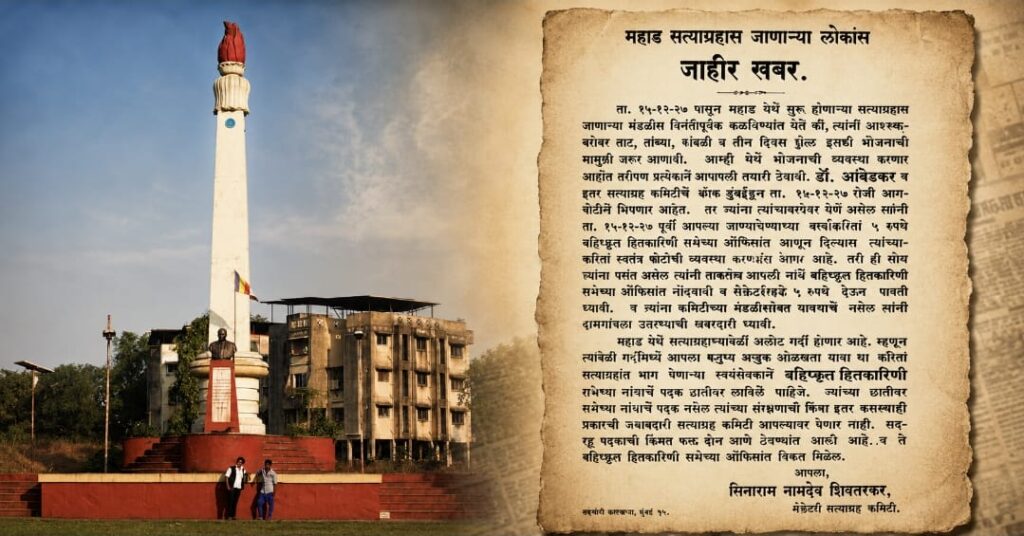
Recognizing this injustice, Dr. Ambedkar organized a conference of the Bahishkrit Hitakarini Sabha at Mahad on March 19–20, 1927. Thousands of marginalized people gathered to discuss education, civil rights, and self-respect.
March 20, 1927: The Historic Day
On March 20, 1927, Dr. Ambedkar led thousands of followers to the Chavdar Tank. He drank water from the public tank, and the gathered people followed him.
This was far more than an act of drinking water – it was a bold declaration against oppression, untouchability, and social exclusion. The event became a defining moment in India’s struggle for equality and human rights.
Opposition from Orthodox Groups
The satyagraha faced severe resistance. Orthodox groups claimed that the tank had been “polluted” and organized rituals to “purify” it. Many participants were attacked.
Despite the backlash, Dr. Ambedkar remained firm, asserting that public resources Mahad Satyagraha Centenary: 100 Years of the Equality Revolution that Changed India’s Social History equally to every citizen and that the struggle for equal rights would continue.
Burning of Manusmriti: A Symbolic Revolt
In December 1927, another conference was held at Mahad, where Dr. Ambedkar and his followers symbolically burned the Manusmriti.
The act represented a powerful rejection of social doctrines that justified caste discrimination and untouchability. It became one of the most significant ideological moments in India’s social reform movement.
Participation of Women
Women also played a notable role in the Mahad Satyagraha. Dr. Ambedkar encouraged them to pursue education, maintain self-respect, practice cleanliness, and organize collectively.
Their participation inspired future generations of women, particularly within the Dalit movement.
Influence on the Indian Constitution
The ideals of the Mahad Satyagraha later found expression in the Constitution of India.
Article 14 guarantees equality before the law.
Article 17 abolishes untouchability.
The constitutional values of justice, liberty, equality, and fraternity reflect the principles for which Dr. Ambedkar fought throughout his life.
Lasting Impact of the Mahad Satyagraha
The movement transformed Indian society in several ways:
It instilled self-respect among marginalized communities.
It inspired organized movements for social justice.
It strengthened campaigns for temple entry, education, and civil rights.
It reinforced democratic ideals of equality and dignity.
Why the Mahad Satyagraha Still Matters After 100 Years
Although India has made remarkable progress in science, technology, and economic development, caste discrimination and social inequality continue to surface.
The Mahad Satyagraha reminds us that rights are rarely granted without struggle. Social transformation requires awareness, unity, and sustained efforts. Dr. Ambedkar’s vision continues to guide those working for equality and justice.
The Mahad Chavdar Tale Satyagraha was not merely a movement for access to water – it was a struggle to secure the fundamental right of every human being to live with dignity.
As India commemorates the centenary of this historic movement, it is an opportunity to pay tribute to all the known and unknown participants who fought for equality. Preserving the constitutional values of justice, liberty, equality, and fraternity remains the most meaningful tribute to the legacy of Mahad.
Rayat Samachar remains committed to documenting the history of social justice, constitutional values, and transformative movements.
(The author, Rahul Jadhav, is a teacher at Shri Shahu Vidyamandir, Khadambe, Rahuri Taluka.)