
PictureShala 1 | A School of Filmmaking in Marathi
Lesson 001 | July 23 | Bhairavnath Wakale
Lesson 001, Topic: Observational Short Film
When we think of films, we often imagine stories, actors, dialogues, dramatic situations, music, and grand visuals. However, the world of filmmaking also has a form in which capturing the reality of life is more important than telling a conventional story. This style is known as Observational Cinema or Observational Documentary, and short films made in this style are referred to as Observational Short Films.
Today, the Observational Short Film style is studied independently at film education institutions around the world. This is because the style helps develop a filmmaker’s powers of observation, patience, and command over visual language.
What Is an Observational Short Film?
An Observational Short Film captures an event, person, tradition, location, or way of life as it naturally unfolds. The director does not create or manipulate the event; instead, they remain a witness to it. As a result, these films can communicate the experience of reality in a more powerful manner.
Key Features of This Style
Absence of artificial acting or scripted dialogues
Preference for natural or ambient sound
Minimal or no use of voice-over
The camera assumes the role of an observer
Realistic visual composition
Allows viewers to interpret and think for themselves
What Should Students Learn?
The most important skill while making an observational film is observation. Students need to sit quietly in a particular location and study the movements, behaviour of people, changes in light, sounds, and atmosphere around them.
To create a good observational film, students should focus on selecting the right subject, filming patiently, avoiding unnecessary zooms, pans, or visual effects, preserving natural sound, and maintaining a sense of reality through minimal editing.
There are numerous subjects that can be explored through this style, such as weekly village markets, cattle markets, fairs and pilgrimages, railway stations, bus stations, farmers sowing and harvesting crops, life along riverbanks, temple surroundings, the Pandharpur Wari, the lives of fishermen, mornings and evenings in cities, artisans at work, and traditional occupations.
Why Is This Style Important?
In an era of fast-paced editing, visual effects, and artificially constructed narratives, observational films keep us connected to reality. They document society, culture, and ways of life. Therefore, they can serve as valuable references for future researchers, students, and film scholars.
A large budget, famous actors, or expensive cameras are not necessary to make a film. With a sensitive social perspective, the habit of observing closely, and the willingness to present reality honestly, an excellent observational short film can even be created using a simple mobile phone.
A Contemporary Example: ‘Dindi | Way of Life’
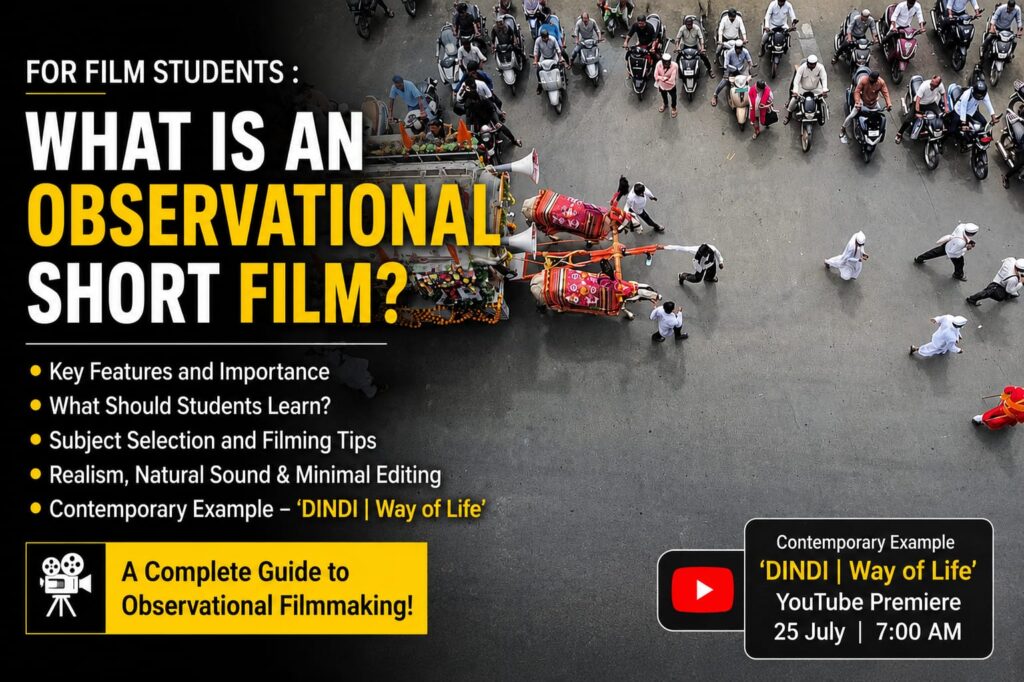
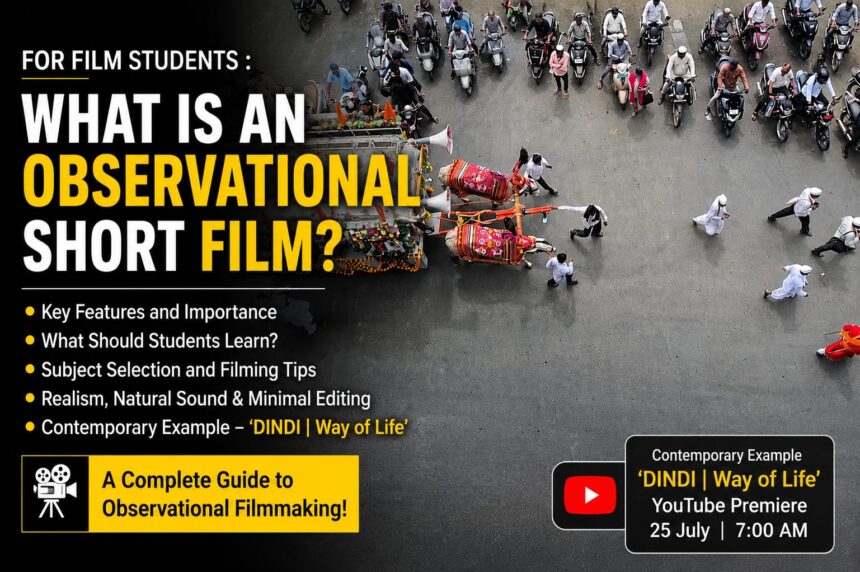
As a contemporary example of this style, viewers can watch ‘Dindi | Way of Life,’ a recently produced film by Rayat Chitra Films. The short film is scheduled to premiere on YouTube for the first time on July 25 at 7:00 AM, on the occasion of Ashadhi Ekadashi.
The film can be watched through the YouTube Premiere link provided with the original article.
Observational Cinema: A Way of Seeing Life
An Observational Short Film is not merely a filmmaking genre; it is a way of looking at life. Every filmmaking student should attempt to create at least one such short film in their lifetime. Such an exercise not only develops filmmaking skills but also encourages people to look at society, culture, and human beings with greater sensitivity.
Global Context
From a global perspective, the documentaries of Frederick Wiseman, Robert Drew, and Albert and David Maysles are considered significant in the development of observational filmmaking.
The realistic films of Iranian filmmaker Abbas Kiarostami, including Close-Up, The Wind Will Carry Us, and Where Is the Friend’s House?, also demonstrate the effective use of observational visual language. Students learning filmmaking are encouraged to study these films.
Some notable examples include:
Primary (1960), directed by Robert Drew – Considered a landmark in the observational documentary tradition in the United States.
Chronique d’un été – An important documentary offering a direct portrayal of real life.
Salesman – A classic documentary observing people in their everyday lives.
High School – A powerful portrayal of reality within a school without relying on explanatory narration.
Titicut Follies – A highly discussed and influential work in observational documentary filmmaking.
End of Lesson 001
The first lesson concludes here.
Next Lesson (Lesson 2): What Exactly Is Observation? How Does a Good Director See?
In the next lesson of the PictureShala series, we will explore the art of observation and methods to develop this essential filmmaking skill.
━━━━━━━━━━━━━━━━━━
🎬 PictureShala | A School of Filmmaking in Marathi
Learn filmmaking – step by step, with practical examples.
A new lesson every Monday.
━━━━━━━━━━━━━━━━━━
Next Lesson (Lesson 2): What Exactly Is Observation? How Does a Good Director See?
File Name: Lesson_001_Observational_Short_Film