
Court strongly upholds the constitutional rights to free speech and peaceful protest
Mumbai | July 5 | Rayat Samachar
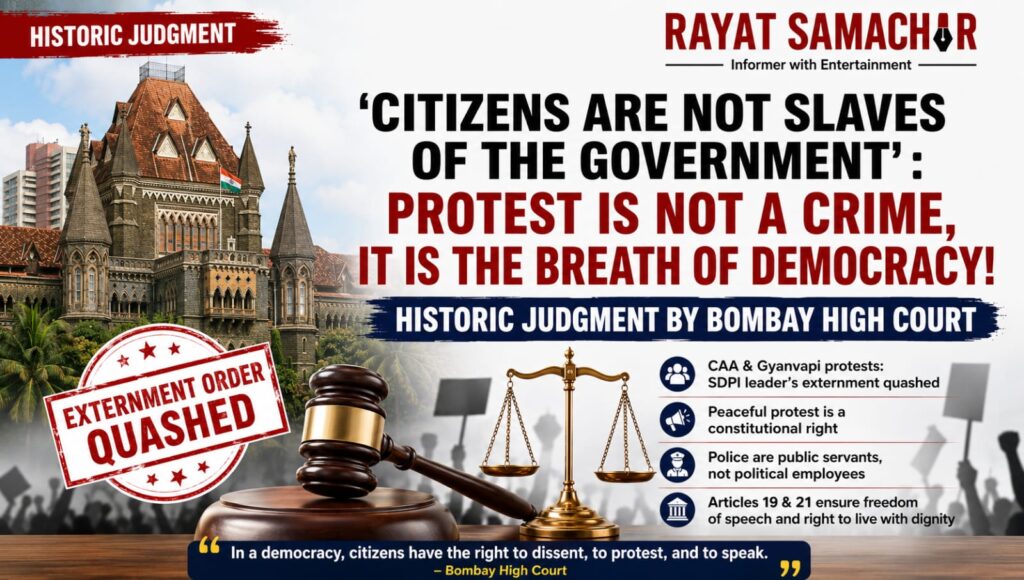
(Protest Rights) In a significant ruling reinforcing democratic values, the Bombay High Court has held that peacefully protesting against government policies is a fundamental right of every citizen and that merely raising slogans against the government or expressing dissent cannot justify an externment order. Justice Madhav Jamdar, while quashing an externment order issued by the police, reaffirmed the constitutional protection of freedom of speech and the right to peaceful protest.
What Was the Case About?
The case involved Syed Ahmed Abdul Waheed Chaudhary, General Secretary of the Social Democratic Party of India (SDPI), who had organised peaceful protests, marches, and sit-ins against the Citizenship Amendment Act (CAA) and the Gyanvapi dispute.
Based on five criminal cases related to these protests, the Mumbai Police had issued an externment order against him for one year under Section 56 of the Maharashtra Police Act. Challenging the order, Chaudhary approached the Bombay High Court.
Court’s Clear Observations
During the hearing, the High Court observed that merely opposing government decisions, organising peaceful protests, or raising slogans against the government does not make a person a threat to society. The Court noted that the police had failed to produce sufficient evidence to justify such a stringent action.
The Court remarked that “Citizens in a democracy are not slaves of the government.” It emphasized that criticising government policies, expressing dissent, and participating in peaceful protests are rights guaranteed by the Constitution.
‘Government Murdabad’ Slogans Are Not a Crime
The Court further observed that raising anti-government slogans, by itself, cannot form the basis for an externment order. Such expressions fall within the protection of Article 19 of the Constitution, which guarantees freedom of speech and expression.
Police Are Public Servants
The Court also made strong observations regarding the role of the police, stating that police officers are public servants, not personal employees of the Chief Minister or the Prime Minister. They are expected to perform their duties impartially and strictly in accordance with the law.
The Court also warned that officials responsible for unlawful actions could face appropriate legal consequences.
Constitutional Foundation
Referring to Article 19 (Freedom of Speech and Expression) and Article 21 (Right to Life and Personal Liberty), the Court reaffirmed that peaceful protest is an inseparable part of a democratic society.
The judgment also relied upon the Supreme Court’s ruling in the Anuradha Bhasin case and similar observations made by the Gujarat High Court, reiterating that citizens cannot be punished merely for opposing government policies.
Externment Order Quashed
The Bombay High Court set aside both the Mumbai Police’s externment order dated December 3, 2025, and the Konkan Divisional Commissioner’s appellate order dated March 27, 2026.
A Landmark Decision for Democracy
According to legal experts, the judgment goes beyond the relief granted to an individual and strengthens the constitutional guarantee of freedom of expression for all citizens. It sends a clear message that criticising the government, expressing dissent, and participating in peaceful protests are not crimes but essential pillars of a healthy democracy.