

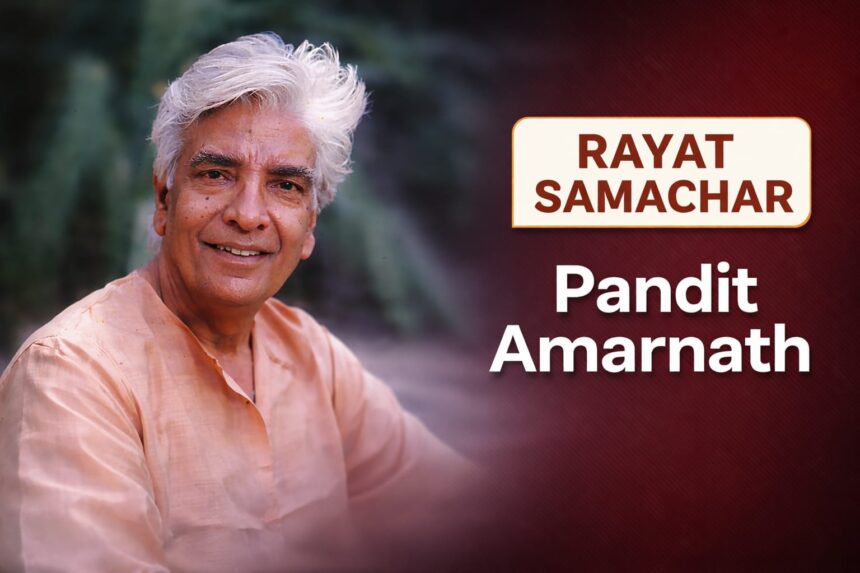
Obituary | March 22 | Rasika Chawla-Layal
On March 22, 2026, the 102nd birth anniversary of legendary Hindustani classical vocalist and composer Pandit Amarnath is being observed. Born on March 22, 1924, in Jhang, Punjab (then undivided India), he remains one of the most distinctive and revered figures in Indian classical music. Often referred to as a “musician’s musician,” his contribution continues to inspire generations.
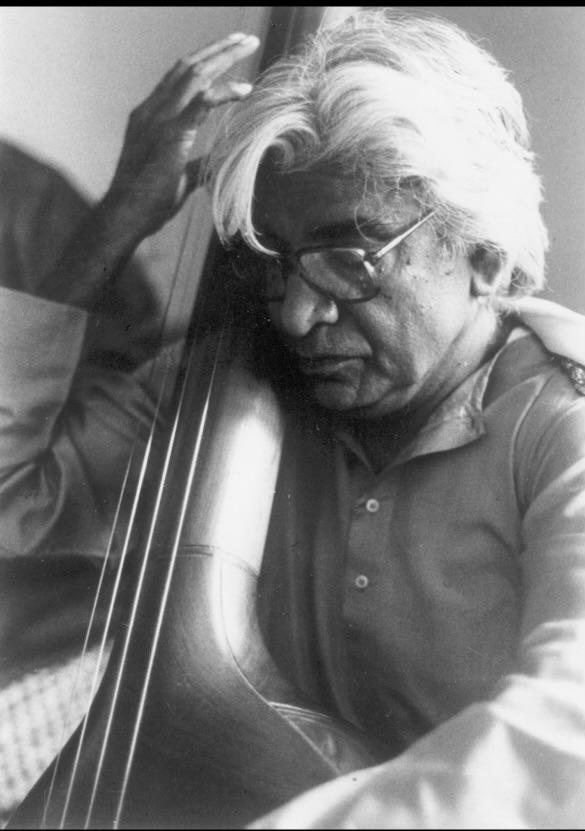
Photo courtesy – Gajra Kottary
Pandit Amarnath received his initial training under Prof. B.N. Dutta. Following the Partition of India, he moved to Delhi, where his musical journey took a defining turn. On his guru’s advice, he approached Ustad Amir Khan for advanced training. Though initially refused, his sincerity and dedication eventually won over the maestro, who not only accepted him as a disciple but also became a father-like figure in his life.
He worked as a composer at All India Radio for eight years and later served as the director of Triveni Kala Sangam. He also taught at Shri Ram Bharatiya Kala Kendra in Delhi, shaping many future musicians. His composition of a Meera bhajan for the film Garam Coat was deeply admired by Lata Mangeshkar, who counted it among her favourites.
Pandit Amarnath also made history as the first Indian artist to perform at the Fogg Art Museum at Harvard University. A prominent exponent of the Indore gharana, he carried forward the legacy of his guru, Ustad Amir Khan, with depth and originality.
On his journey:
“In two words, I would describe his journey as soulful and pure. He was deeply philosophical by nature, and his approach to music was like that of a Sufi saint – unconcerned with worldly success. In my growing years, that was difficult to understand, but later I realised how rare and admirable that quality was. It also became an important learning for me – to be in the world, yet rise above its pettiness and think higher.”
– Gajra Kottary
Beyond his musical brilliance, Pandit Amarnath was a scholar, teacher, and writer. His works include Hansa Ke Ben (a collection of 101 poems), Indore Ke Masiha, and a detailed glossary on Hindustani music terminology. He composed over 200 bandishes and created several ragas such as Amarkali, Gunranjani, Audav Asavari, Maru Basant, Kafi Malhar, and Shyam Bhup. He also adapted Carnatic ragas into the Hindustani style.
He is counted among the great torchbearers of Hindustani classical music, alongside Bade Ghulam Ali Khan, Kumar Gandharva, and Ustad Amir Khan.
On the occasion of his birth anniversary, his daughter, Gajra Kottary, shared her memories and reflections on his life and legacy.
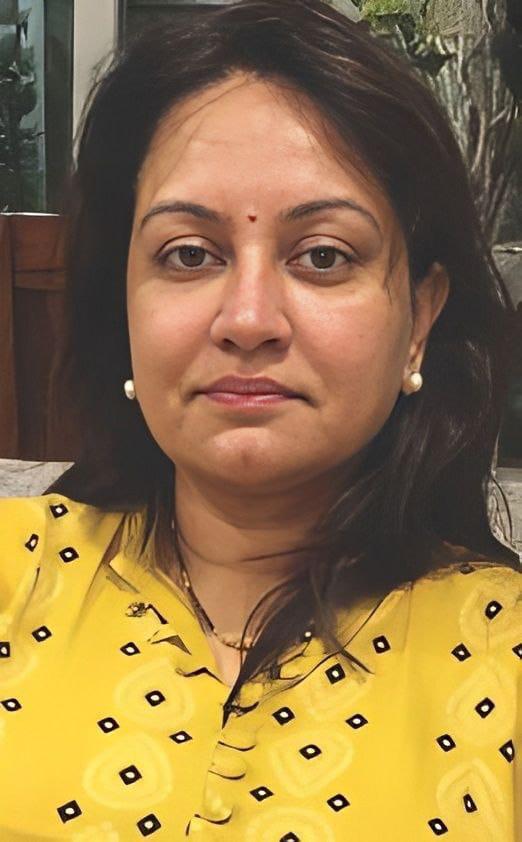
Photo courtesy of Gajra Kottary
On him as a person:
“Beyond his musical genius, he was childlike and always curious to learn. He loved reading and cooking, and with me, his youngest child, his fun side came out more. We watched many films together and discussed their stories, as well as the books he read. He also wrote poetry and explained Urdu couplets to me. He would often say that he might have become a writer if he hadn’t chosen music – so I feel glad that I became one.”
Message to people:
“Panditji valued simplicity and sincerity in life. He disliked any kind of pretence, and that is an important lesson for our times, when many of us pretend to be what we are not. Sincerity towards one’s vocation – especially in the arts – was very dear to him, and it should be for all of us.”
– Gajra Kottary, daughter of Pandit Amarnath
Pandit Amarnath passed away on March 9, 1996, leaving behind an irreplaceable void in the world of music. Yet, his compositions and teachings continue to resonate, touching the hearts of listeners even today.